

October 13, 2024 Bioenergy, Biomass, Net Zero
The UK Government must go further on Net Zero
It is reassuring to read the government’s Biomass Strategy, which acknowledges bioenergy’s role in reaching Net Zero.
Bioenergy heating is the most reliable sustainable heat source for off-grid buildings, which would otherwise rely on oil boilers, whose annual CO2 emissions are measured by the tonne. Bioenergy, on the other hand, is a renewable and even carbon-neutral alternative.
It’s encouraging to read that government is firmly in favour of bioenergy, and having published its biomass strategy, it’s now time for the government to implement it with concrete action. A large part of that action should be support for businesses with the upfront cost of switching to biomass heating.
Here’s what the strategy states, what it means for commercial heating, and what the next steps should be for the government and businesses.
What is the government’s Biomass Strategy?
The government’s Strategy Policy Paper reads:
‘Biomass is a versatile resource and can be used to produce almost any type of energy, including power, heat and transport fuels, while also offering opportunities to replace fossil fuels in chemicals, materials, and products.
The Biomass Strategy sets out steps government intends to take to strengthen biomass sustainability and the opportunities for the use of sustainable biomass across multiple sectors of the economy in support of achieving the UK’s net zero target.’
The endorsement of biomass as a source of power and heat will reassure businesses and industry that their own green strategies can and should include bioenergy, and that in doing so they will pull in the same direction as state initiatives and regulations.
The Biomass Strategy, carbon capture, and Net Zero
The Biomass Strategy emphasises the importance of bioenergy carbon capture and storage (BECCS). BECCS captures the carbon released by burning biomass, and stores it permanently.
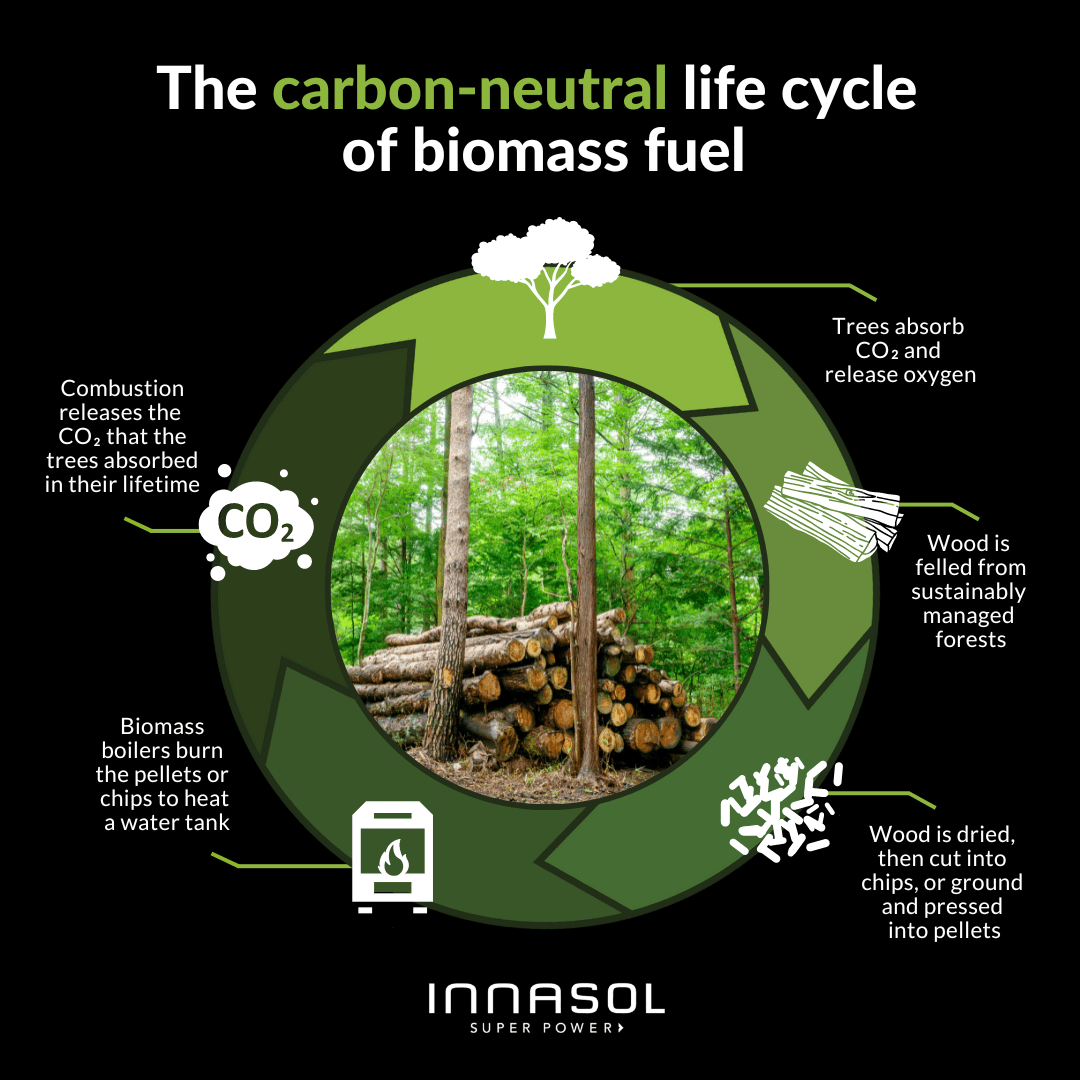
Bioenergy on its own can be carbon-neutral, but BECCS makes it carbon negative. In the typical bioenergy carbon cycle:
- trees absorb carbon dioxide
- sustainable forestry creates timber
- off-cuts from the lumber industry become bioenergy pellets
- Burning those pellets releases carbon that was absorbed by the tree in its lifetime
- living trees absorb that carbon
Carbon capture breaks the cycle, so that trees continue to absorb CO2 but using bioenergy doesn’t re-release it, ultimately reducing the amount of carbon in the atmosphere.
The next steps
It’s vital that the government backs their biomass endorsement with concrete action. Innasol’s Sales Director, Terence McCracken, is chair of the Wood Heat Forum at the Association for Renewable Energy and Clean Technology (REA).
‘On behalf of the REA Wood Heat Forum, I welcome the publication of the Biomass Strategy and its significant contribution towards the delivery of the sixth carbon budget by 2035. The report makes clear that biomass boilers have a key role to play especially when it comes to addressing hard-to-treat sectors. The strategy demonstrates that there are around 220,000 off-gas grid domestic properties where biomass boilers are a viable and appropriate solution to decarbonisation, while also recognising that biomass will directly contribute to the wider decarbonisation of industry.
This huge opportunity, despite being several times larger than the current UK biomass heat sector, is not without its challenges. New biomass boiler deployment has slowed in recent years due to significant gaps in heat decarbonisation policy, particularly since the closure of the domestic and non-domestic Renewable Heat Incentive. The Wood Heat Forum is calling for this to be addressed as a matter of urgency. The biomass boiler industry stands ready to help with further evolving training and accreditation, strong supply-chain sustainability and air quality standards that come from high-quality installations and, in turn, delivering considerable carbon savings.’
Unfortunately, even when the government’s announcements and policies are environmentally sound, it has a poor record of offering tangible support for change.
For example, with the closure of the Renewable Heat Incentive (RHI), there is no viable scheme to support businesses with the upfront cost of installing a bioenergy boiler. Given that by the government’s own figures, the heating of buildings contributes 23% of the UK’s carbon emissions, it should more urgently support the transition to zero-carbon alternatives.
What does this mean for your business?
Realistically, the absence of support schemes mean some businesses will struggle to make the switch.
Despite offering no support, the government is still planning to ban new oil boilers in 2026. If that ban goes ahead, and you’re replacing your oil boiler after that date, you won’t be able to make a like-for-like replacement.
The government is setting up its own ban for failure. A renewable heating system requires financial outlay that not every business is in a position to make. Imposing a ban without support means many businesses will be left with old and possibly failing oil boilers that they can neither afford to replace, nor afford not to.
Aside from the fact that it will leave some businesses with unreliable heating, it will also leave in place the heavily polluting (and increasingly inefficient) boilers that the government’s ban intended to phase out.
The need for financial support cannot be overstated. Homes have some assistance in the form of the Boiler Upgrade Scheme, but there is no business-focused funding available. That needs to change urgently.
Innasol will continue to call on the government to offer support for businesses, but in the meantime, if you are thinking about a switch to sustainable power for your home or business, whether that’s renewable heating or green electricity, call 01621 892613 for a no-obligation discussion.
Our network of bioenergy heating engineers covers the entire country, and there will be someone in your area who can discuss the options for a switch, your circumstances, and help you address any concerns you might have about the affordability of your boiler.


